Stolen Teenage Years
What Straight Viewers Miss About Heated Rivalry
Mike O'Connor
3/17/20265 min read
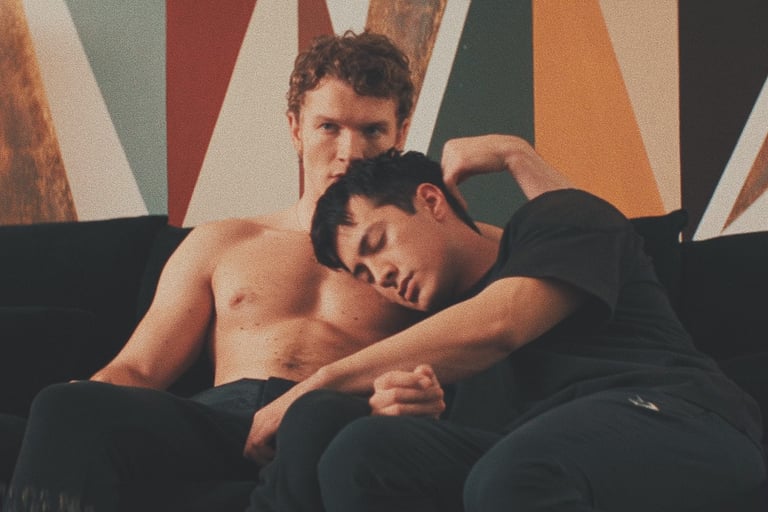
It seems like everyone has a lot to say about Heated Rivalry, the gay hockey love story series that's been adapted from a popular romance novel. As a gay man who works with other gay men, I've been watching this discourse closely. When straight audiences critique gay romance as 'physically rushed' or 'emotionally flat,' they are often revealing more about their own assumptions than the story's flaws. To watch the discourse around Jacob Tierney's hit series is to watch a large swath of the audience try to fit a queer square peg into a heterosexual round hole. They are searching for the recognizable beats of a traditional rom-com. But what if the emotional landscape it portrays so accurately isn't a failure of pacing, but a mirror of a lived reality that most straight viewers have never had to face? They miss the core truth at the heart of the show: that for many queer people, the traditional teenage milestones of romance and self-discovery are not just delayed, but stolen entirely.
Growing up straight, teenagers get practice time. As a heterosexual teenager, you get years of low-stakes practice: crushes, hand-holding, being awkward in public, getting rejected and surviving it. From fifth grade, your classmates help you pass notes asking out someone. In middle school, you may have a grandparent who gives you additional support with awkward conversations you don’t want to have with your parents. In high school, your entire friend group can help you decide on which person to ask out to prom, while parents offer advice, share their own stories, and quietly partake in the rituals. Your first hand-hold, kiss, date, and even going to all the bases, can be spread out over years, institutions, and contexts. You get repeated trials and a nervous system that grows and learns from those errors, with the support of parents watching you from the roller rink sideline. Of course not every straight teenager has all of these either, but it’s allowed.
Heated Rivalry exposes all the innocence that’s stolen from queer teenagers.
The reality for queer teenagers growing up is the absence of that. We miss out on our ‘firsts.’ Teen years are supposed to be messy, cringe, and experimental. For closeted queer kids, that messiness isn’t allowed, because they can’t yet be themselves. We don't get to ask our parents the questions straight kids ask—How did you know you liked someone? What do I say on a first date?—because those questions would require a confession we can't yet make. So we navigate firsts not just without peers, but without the quiet reassurance of adult wisdom. So we get good at acting normal and performing a cover-story. Instead of learning how to let intimacy grow, we get good at self-editing and surveying risk. Don’t look too long. Don’t talk too soft. Don’t let your body show anything. When we should be having opportunities to practice and grow in relational contexts with our emotions and actions, we are instead praying to God our opposite-gendered prom date doesn’t try to kiss us or wondering how long into the future this façade can be maintained. This has serious consequences, from severing ties with family to self-harm. Organizations like The Trevor Project have long warned that queer youth face real mental-health risk when support and safety aren’t there.
I received many responses to an online video on this topic, many from gay men who described adolescence as a period of repression rather than exploration. In my work facilitating retreats for gay men, I hear a repeated pattern: many grew up assuming they’ll never have the kind of partnership their straight peers take for granted. For those that eventually come out and start engaging in romantic endeavors, the stolen teenage years and missed firsts sometimes arrive all at once, and intensely. A first kiss can be the same moment as a first everything.
And this is the choice we see that the show makes: it brings the characters together sexually within the first fifteen minutes. While sex sells (and it does), it is also symbolic of how queer lives unfold. It is much harder to build emotional intimacy first when you haven’t had the opportunities to practice that kind of intimacy. In comment threads, a common complaint is that the sex comes too soon, that it feels like ‘porn with a paper-thin plot,’ or that the romance has no script.
Some of the contrasting views between straight and gay audience responses can be seen in the final episode. The couple, two men whose relationship spans ages seventeen to twenty-six, finally spend longer than a few hours together. One character says, while noting he bought food for the planned two weeks: ‘I would like to relax with you for once.’ Online, straight viewers have fixated on the grocery run as the emotional gesture. As a gay viewer, the nervous system context stands out: the story’s real hinge is that ‘for once’ comes nine years in, paired with something semi-public: holding hands in the car.
This is why straight viewers commenting that the sex is too fast reveal that they are not tuning in to a gay or queer development reality but viewing it through straight scripts. The secrecy, risk, and pacing aren’t romantic. They’re constraints. It’s a result of missed opportunities and stunted messiness. Yes, male-male relationships often have different dynamics around sex than heterosexual ones. But the common stereotype, that gay men revolve their lives around sex, frames these relationships as inherently immature or unstable, when in fact they’re often operating under different conditions and without a culture to mirror them.
When viewers praise the grocery run and miss the real milestones of permission to let your guard down, this comes across as empathy failure and not a taste difference. Even when straight viewers are attracted to the symmetry of the partnership’s power dynamics and that stands out as refreshingly different, the criticism still grades the relationship against a straight timeline. That misses what the story is actually staging.
If the show changes anything, let it be the frame. Queer stories have different arcs than straight coming-of-age ones. They exist to tell the truth about what it costs to build intimacy when early practice was withheld. If we want queer stories to do more than entertain and be read on their own terms, we have to critique them through the conditions that shape them, including the years of practice many people never got. Until straight audiences learn to see that difference, queer romance will keep getting reviewed as fantasy, when it is often reporting from life.